I Am a Health Professional
Home » I Am a Health Professional
As a healthcare professional, you may be wondering how to support a child or young person who has or had cancer in your role.
Here, you’ll find some information and resources which may be helpful, as well as relevant application forms. Please reach out with questions that you might have on how best to support a family.
The Children and Young People’s Cancer Association – CCLG – in the UK provides trusted information and guidance for healthcare professionals.
Signs and symptoms of childhood cancer
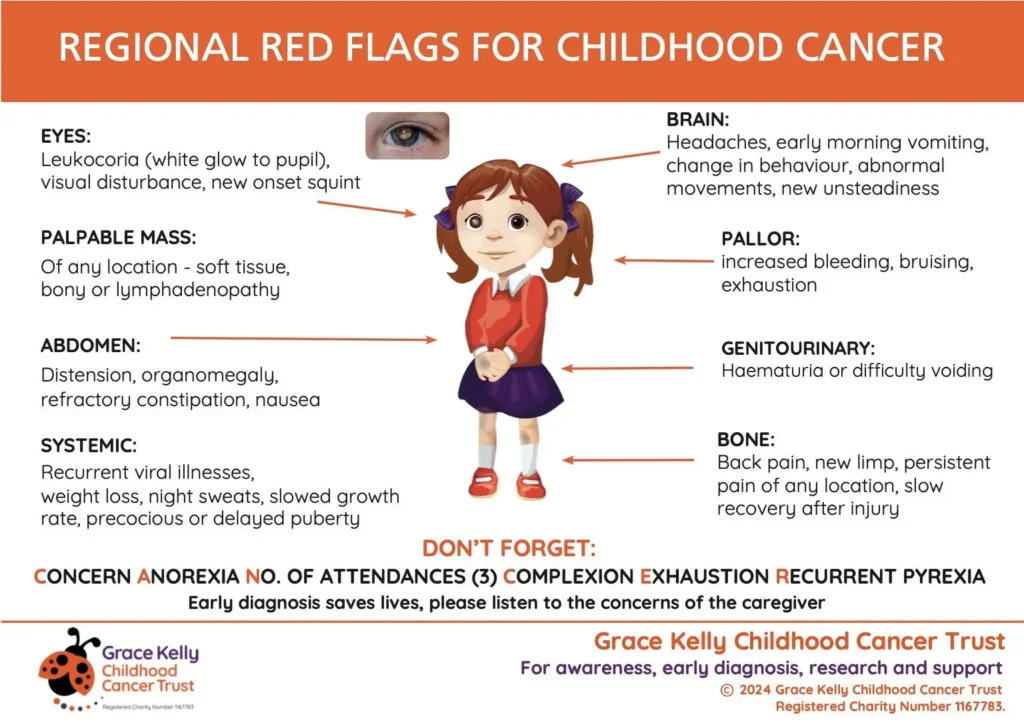
The Grace Kelly Childhood Cancer Trust has developed resources to help healthcare professionals to identify the signs and symptoms of childhood cancer, as many cancers can present as normal childhood illness.
Look for:
symptoms that are persistent, unusual or worsening – for example well-localised pain that wakes a child up from sleep.
- recurrent attendances (thought to increase the chance of a cancer diagnosis up to ten fold).
Accessing Childhood Cancer Ireland Supports
General Referrals
If you’d like to refer a patient to any of our supports, please complete this short form.
(form available soon)
Education Supports
We offer a number of supports that can help parents, children and young people in education.
Institute of Education Grinds
Childhood Cancer Ireland students can access free part-time courses and grinds with the Institute of Education. All courses are online and students can enrol in a maximum of two subjects.
Exam Revision
ExamRevision is an online study platform that helps Junior and Senior Cycle students revise. We have a limited number of logins to access this resource available to Junior and Leaving Certificate-year students.
If you have a patient interested in either of these education supports:
Relapse Grant
Childhood Cancer Ireland provides financial support to parents and guardians of children, adolescents and young adults who have received a diagnosis of relapse of childhood cancer.
Eligibility
To be eligible for this grant, the patient must:
- Be under 24 years of age
- Have received a diagnosis of relapse of childhood cancer
- Have relapsed after 1 June 2025
- Have been permanently resident in Ireland
Definition of Relapse
For the purposes of this grant, relapse is defined as:
The return or progression of childhood cancer after a period of remission, confirmed by a treating medical team. This may include local, regional, or distant recurrence of the original cancer, requiring further treatment such as chemotherapy, radiotherapy, immunotherapy, stem cell transplant and surgery.
Relapse must be clinically verified by the healthcare team and result in the child, adolescent, or young adult being re-engaged in active cancer treatment at the time of application.
Treatment Status
The patient must be in active treatment for relapse at the time of application.
Residency
The child, adolescent or young adult must be ordinarily resident in Ireland.
Grant Status
Grant applications can be made per relapse. Where a child has multiple relapses, each application will be dealt with on a case-by-case basis, within the parameters of the eligibility criteria and in consultation with the hospital team, where necessary.
How to Apply
An application can be made by a parent or guardian of the child, adolescent or young adult who has relapsed, or directly by a young adult over the age of 18. Applications can also be made on their behalf (with their consent) by the Social Work Department of the treating hospital.
Bereavement Grant
Our bereavement grant offers financial support to families during this incredibly difficult time, helping families to feel supported and allowing them to focus on their emotional wellbeing without the added burden of financial stress.
Eligibility
To be eligible for this grant, the patient must:
- Be under 24 years of age
- Have died as a result of childhood cancer
- Have died on or after 30 June 2024
- Have been permanently resident in Ireland
How to apply
Applications can be completed by parents/guardians, or on their behalf (with their consent) by the Social Work Department involved in a child’s care, whether in the treating hospital, hospice, or a hospital or community-based palliative care team.
Contact Us
If you have any questions about how to support a patient or family that you are working with, please get in touch.