I Am a Survivor
Home » I Am a Survivor
Life After Childhood Cancer
Thankfully, more children and young people are surviving cancer than ever before. But we know that survival is not the end of the journey.
At Childhood Cancer Ireland, we believe that survivors deserve lifelong support. Support that protects physical health, emotional wellbeing and helps every survivor enjoy the best possible quality of life.
Being a survivor: what does it mean?
Maybe you don’t like the word survivor! Lots of people don’t – although we have yet to come up with a good alternative so we will use it here.
Many survivors move forward with few or no long-term challenges. Others may experience physical, emotional or cognitive effects related to their cancer or treatment and need ongoing, specialist support.
Life after cancer looks different for every individual.
Identity
Cancer was a part of your life but how much of your identity does it form? There is no right or wrong answer and everyone has their own thoughts and feelings on that. You might be glad to have an opportunity to leave cancer behind and for people not to know about it. Or you might want to tell a new employer or new friends or colleagues but are unsure how they’ll react. It’s ok to be still figuring these things out, even years after treatment.
If you’d like to hear about the experiences of other survivors, you’ll find lots of young people on our podcast Gold Ribbon Conversations.
Our belief: connecting the dots
We believe Ireland needs a national, comprehensive, and structured long-term survivorship support service that one that:
- Identifies potential issues as early as possible
- Ensures consistent follow-up across childhood, adolescence, and adulthood
- Supports both physical and mental wellbeing
Survivors have earned this care.
We support and represent survivors and their families, and we work to ensure their voices are heard — guided by the principle:
“Nothing About Us Without Us.”
Possible long-term and late side effects
While many side effects resolve after treatment ends, some long-term effects, such as fatigue, may take time to improve. Other effects, known as late effects, may not become apparent until months or even years later.
Whether a survivor experiences late effects depends on many factors, including:
- The type and location of cancer
- The type and intensity of treatment or surgery
- Age at diagnosis
- Personal and family health history
Types of late effects
Late effects may be physical, emotional, or cognitive. Some families want detailed information, while others may find this overwhelming. Both responses are completely valid. You can always speak with your healthcare team about concerns at any stage.
Possible physical effects
These may affect growth, development, or energy levels. Some survivors experience multiple physical effects, while others experience very few.
Possible emotional effects
Emotional effects can include changes in mood, behaviour, or social confidence. Many children and young people show great resilience, while others may experience anxiety, low mood, or sleep difficulties. If concerns arise, it’s important to talk to your doctor.
Possible cognitive effects
Cognitive effects may affect memory, learning, or concentration. These types of late effects are more likely to occur in children or young people who’ve had certain cancers, such as brain and spinal cord tumours, head and neck cancers, and some types of leukaemia. Again, the likelihood of these effects depends on the age of the child during treatment and the type and duration of treatment.
(Source: National Cancer Institute – www.cancer.gov)
Plain-language summaries of common late effects
PanCare, is a pan‐European network of professionals, survivors and their families which works with the European Community to increase awareness and research about childhood cancer survivors. PanCare has developed plain-language summaries with information about late effects for survivors, as well as their non-specialist healthcare providers, relatives and friends.
Topics include cancer-related fatigue, hair loss, heart and hearing problems, to name a few. Pancare Plain Summaries.
Follow-up Care
Follow-Up Care Clinics / Survivorship Clinics
On completion of treatment, children will continue to be monitored closely, within an out-patient follow-up clinic. The emphasis of these clinic visits is to monitor for disease recurrence but also to start monitoring for any potential long-term side effects of treatment.
Generally, after about two years of such follow-up, the emphasis shift from disease recurrence to that of monitoring for potential long-term side effects. Such clinics are often referred to as survivorship clinics.
At these clinic visits, your child will continue to see their consultants / medical / nursing team. In addition to this, and if necessary, your child may be referred to another specialist for more specific medical management. For example a specialist in cardiology, endocrinology, fertility, nutrition, psychology or pulmonology.
Graduation/Transition from CHI
Usually, your child will continue with CHI-centred follow-up for at least five years following completion of their treatment before graduating from follow-up. Some children may require longer follow-up, possibly up until 16 – 18 years of age before they graduate. The timing of graduation, and where your child graduates to, is variable relative to your child’s diagnosis, their treatment received and their need for ongoing medical management if applicable. The options of where your child graduates to after CHI can range from not requiring any specific further follow-up, to GP/community follow-up or possibly even to hospital-based adult care follow-up.
Your child’s medical and nursing team will help prepare you and your child to graduate/transition from CHI-centred care. This transition requires careful and accurate relaying of your child’s medical information to ensure your child and you as parents are fully in the knowledge of such. There are two important ‘documents’ that are important to ensure nothing is ‘lost in translation’ when your child graduates from CHI-centred/paediatric to community / adult care.
- Medical summaries: an important first step
A medical summary is compiled by your child’s medical / nursing team on completion of their treatment, and is updated at each visit thereafter. This medical summary is freely available to you or your child at any time, however it is imperative you or your child receives a copy of this summary when your child graduates from CHI.
This summary will give any other healthcare professional your child may encounter, a good insight into your child’s medical history.
- Survivorship care plans
A very promising initiative by the CHI team is now starting to be rolled out – the Survivorship Care Plan (SCP). This SCP is given to survivors when they graduate from CHI.
In addition to incorporating the above medical summary, the SCP contains international surveillance/screening recommendations relative to the specific treatment your child received.
This SCP has the potential of empowering all survivors to be aware of their cancer diagnosis, the treatment they received, the treatment-related late effects they may have and importantly, the international recommendations on how to monitor such in the future. As a result the SCP promotes survivor confidence, self-responsibility and healthy behavioural lifestyles. In addition, the SCP may empower the survivor to help educate any health-care professional they may come into contact with in the future thereby guiding future management.
The emotional side of life after treatment
You have weathered an enormous storm. It is normal to experience a wide range of emotions as life settles into a new rhythm after treatment.
These emotions may include:
- Fear of recurrence
- Anxiety
- Guilt
- Grief
- Gratitude and joy
Knowing that other families and survivors share these feelings can help reduce isolation and foster understanding.
Emotional Support
Childhood Cancer Ireland provides one-to-one psychological support as a safe space for you to explore your emotions, make sense of your experiences, and feel supported every step of the way.
New Support: Life After Childhood Cancer Treatment
We have launched a brand new family support programme called Life After Childhood Cancer Treatment.
From managing fatigue and emotional wellbeing to navigating school, friendships and follow-up care, life after childhood cancer treatment can raise new questions, challenges and worries for the whole family.
This is the first initiative of its kind in Ireland, created specifically to support families in the months and years after treatment ends.
The programme covers common challenges you may face, such as changes in energy levels (fatigue), difficulties with concentration or learning and the emotional impact of treatment.
Mental Health
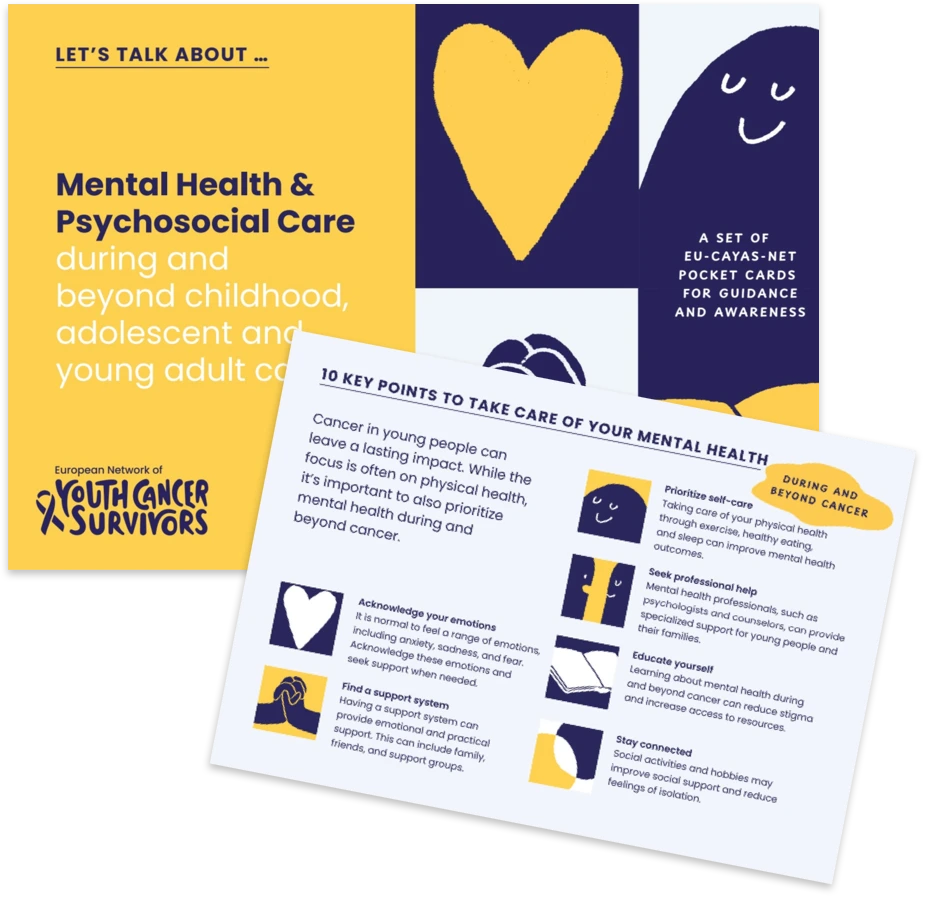
EU-CAYAS-NET is a European network of youth cancer survivors working to empower young people to advocate for their rights and needs.
Together, survivors across Europe have created Mental Health Pocket Cards. These are simple, practical tools that help young people explain their experiences and start conversations about mental health.
The pocket cards can be shared with healthcare teams, schools, colleges, employers, friends, or family, and include clear information, key messages, and practical tips.
Access the Mental Health Pocket Cards
Fertility
Some chemotherapy drugs may temporarily or permanently affect your ability to have children.
Find out more about your fertility options
- Irish Cancer Society’s Fertility Project. This project offers free fertility preservation and other services to young people with a cancer diagnosis, including:
- Children who have yet to reach adolescence
- Female survivors of childhood cancers aged between 18 and 27
- SIMS Clinic for fertility preservation for those aged 18+ before they start chemotherapy.
CanTeen
CanTeen Ireland is a registered charity and the nationwide support group for young people between the ages of 12 and 25 years who have, or have had cancer.
It provides an opportunity for young people who have been affected with cancer to meet up in a relaxed and informal setting and to attend fun activity weekends away together as a group. It’s a great, fun way to meet people who have had a similar experience without cancer being the focus of every conversation – everyone just gets it.
School
When you were in treatment and in recovery, you may have missed a lot of time from school. There are some supports that can help.
Institute of Education
Childhood Cancer Ireland students can avail of free part-time courses and grinds with the Institute of Education so that students who have / had cancer can access this support.
Career Guidance
Our Career Guidance Programme is designed to support students by connecting you with a qualified and experienced Career Guidance Counsellor to help you choose subjects, explore career paths and make informed decisions about their future.
Further and Higher Education
If you are planning for a move into further or higher education, DARE can help.
What is DARE?
If you have or had cancer, are under 23 years of age and applying for college, you are eligible to apply for the Disability Access Route to Education (DARE) entry scheme.
DARE is designed to compensate for the impact that cancer has had on your education. Successful applicants can avail of college or university courses that they may not have gotten the points for through the standard application process.
In order to be considered for DARE entry, you must have completed the Leaving Certificate (you can apply while in sixth year, at the same time as filling out the CAO), be aged under 23, and have a disability or significant ongoing illness. Childhood or adolescent cancer comes under the significant ongoing illness category.
You will need to provide evidence of your treatment and its impact with your DARE application. You can find out what you will need to submit as evidence on the DARE website.
We have held webinars on DARE, the CAO application process and the supports that are available at 3rd level.
Finance
If you are over the age of 18, you might be interested in connecting with a qualified financial advisor, who can offer free access to financial advice, information and planning to help you manage your finances and plan for the future. Find out more.
Have your voice heard
Through our advocacy work we can help to make change. Adding your voice to that can be empowering and help you to take back some control and to share your story to effect change.
If you would like to get involved in advocacy in any way, or to share your experience, contact us .
The annual CAYAS Conference (Childhood, Adolescent and Young Adult Cancers & Survivorship) highlights the lived experience of parents, families, patients, and survivors by providing them with a platform to collaborate and connect with medical experts, healthcare researchers, and others. As a survivor, this is a great conference to hear about the experiences of others, to meet other young people and to have your voice heard if you’re ready for that.
Standing with survivors
At Childhood Cancer Ireland, we are committed to standing with survivors and their families for the long term, ensuring no one is left to navigate life after cancer alone.